
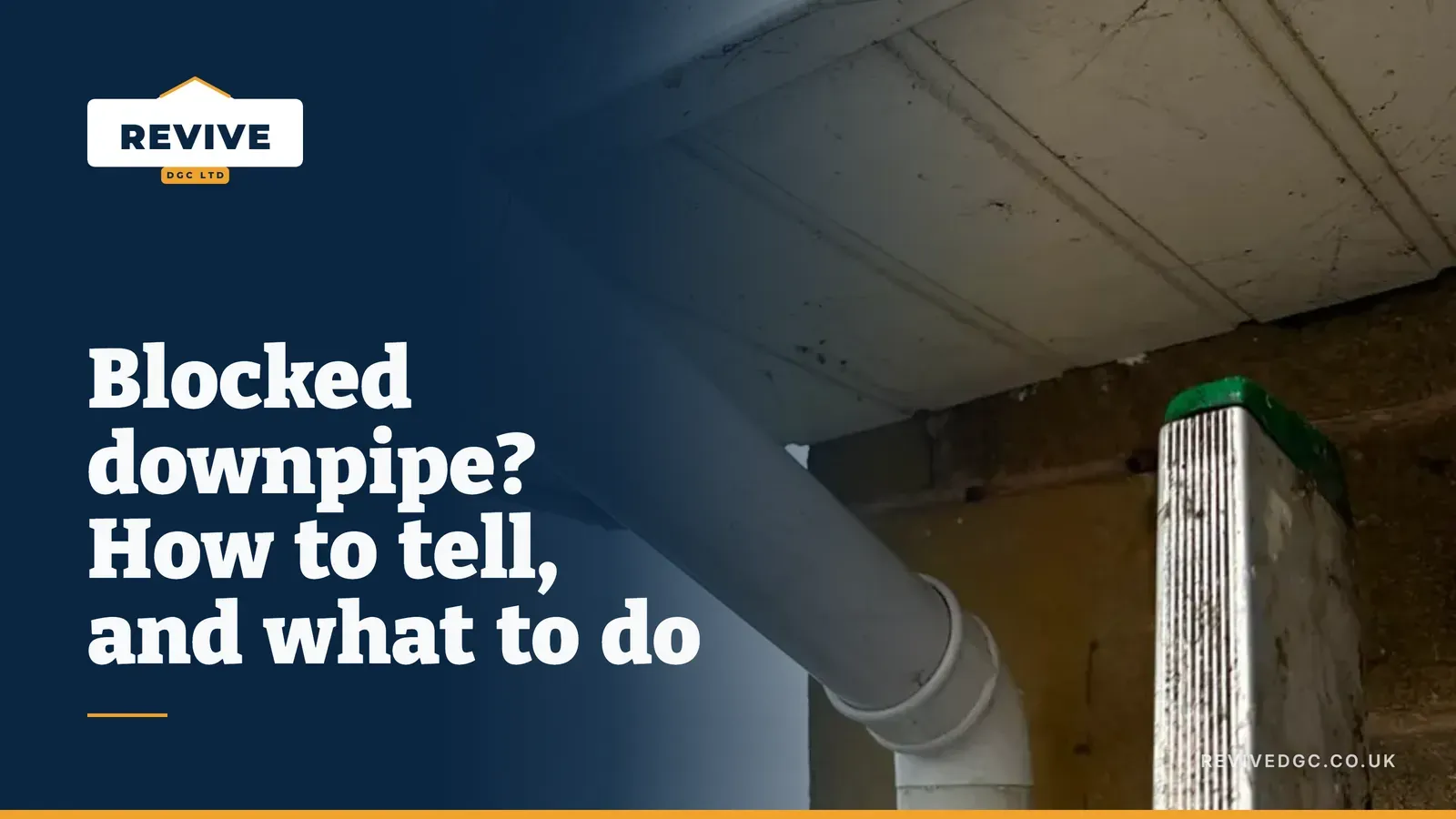
You've probably noticed it in a heavy shower: the gutter at one corner of the house spills over in a sheet, right where the downpipe drops away, while the rest of the run copes and barely a trickle comes out of the bottom of the pipe. Those are the classic signs of a blocked downpipe, and the blockage is often up near the top, in the outlet or the bend just under the gutter, where you can't see it from the path.
It's one of the easier faults to read from the ground once you know what you're looking at, and well worth catching before the water's had a whole winter to soak into the wall. A few minutes outside in the next proper downpour will tell you most of what you need.
How do you know it's a blocked downpipe and not the gutter?
Put a coat on next time it rains hard and watch where the water goes. A gutter full of muck tends to spill over the front edge along the run, wherever the silt's built up. When the pipe's the problem, the gutter itself might be fairly clean, but the water reaches the outlet, has nowhere to go and backs up, so the spill is worst at that end while the rest of the run looks almost normal.
Then look at the pipe. If it's dry or just dribbling at the bottom while the gutter above is overflowing, something's in the way. Some pipes gurgle and splutter as the water fights past a partial blockage, and on a dry day a pipe that's packed solid can sound duller than an empty one when you tap it. None of those proves it on its own, but two or three together make a blocked pipe the likely answer.
If the water's coming over the front all the way along, it's more likely the gutter that needs emptying, and my article on how often to get gutters cleared covers that side of things. It can easily be both, because the muck that fills a gutter is the same muck that washes down into the pipe.
Where downpipes block, and what's usually in there
Water leaves the gutter through the outlet, a short spout in the bottom of the run, and on most houses the pipe can't drop straight down from there because the gutter sits out past the wall. So it goes through a pair of bends, usually called a swan neck or an offset, to bring it back in against the brickwork. Those bends are where things catch. A clump of moss wedges in the first turn, leaves pack in behind it, and before long the whole neck is solid.
The other spot is the bottom. Some pipes end in a little kicked-out shoe over a drain grate, and some run straight into the ground. One that goes into the ground can block at the bend underneath, or the trouble can be further down in the drain itself, which is a different job altogether.
What blocks a downpipe is mostly whatever's in the gutter above it: moss off the roof, leaves from nearby trees, and the fine black silt that builds up in a gutter nobody's touched for a few years. If your roof has a good covering of moss, the pipes will keep getting the bits that break off it, which is why I clear the gutters out after every roof clean.
Why is water coming out of the joints halfway down?
This one worries people, because it looks like the pipe's broken, but usually it isn't. Downpipe lengths simply push into each other and aren't sealed the way gutter joints are, because in normal use the water falls straight down the middle and never troubles the joint. When the pipe blocks lower down and fills up, the water rises until it finds the first gap, and out it comes, running down the wall in a dark stripe. Leave that going for long enough and you can end up with the sort of green stripe on render that people then pay to have cleaned off.
So water at a joint is often a sign of a blockage below it rather than a reason to replace the pipe, and once the blockage is cleared the joints usually go back to being dry. Frost is the exception. Water sitting in a blocked pipe can freeze, and ice in a full plastic pipe can split it or push a joint apart, and that's when a length or a bend does need replacing.
What you can safely try from the ground
Start at the bottom, because that's the bit you can reach with both feet on the floor. If the pipe ends over a drain grate, lift off any leaves sitting on the grate and have a look at whether the gully underneath is full. If it's the gully that's overflowing, the blockage is in the drain rather than the downpipe, and it's worth mentioning that when you get in touch.
If the pipe ends in a shoe above ground, you can sometimes see up it with a torch, and a handful of muck right at the bottom will come out with a gloved hand or a bent coat hanger. That's about where I'd stop. I wouldn't go up a ladder to push a rod or a hosepipe down from the top, because you're leaning on a plastic gutter with water spraying back at you, and shoving hard from above can pack the blockage tighter into the bend instead of shifting it. I wouldn't turn a pressure washer up it either.
How I sort it out
I do gutters from the path with a high-reach vacuum, so nothing gets leant against your fascia and nobody walks on your roof, and clearing the outlet and downpipe is part of a gutter clear, not something I leave for another visit. Emptying a gutter into a pipe that's still blocked just means it fills straight back up in the next storm, so there's no sense doing one without the other, and I take away whatever comes out.
If a length has split, a bend has cracked or the pipe's been knocked off its clips, I'll show you and price the repair, and if it's one cracked bend, that's what you pay for. There's no reason to take the whole run down for it. Before and after photos land on your phone even when nobody's in, so you can see how the pipe and gutter have been left. Someone listed under Rotherham on my MyBuilder reviews had me out for a blocked downpipe back in September 2021, and what they put was "Quick and efficient came out same day". I can't promise the same day every time, but once you've had the quote, it's usually a week or so before I'm there, weather allowing.
What decides the price
I don't give prices over the phone for this, because the same symptom can turn out to be a quick job or a much longer one. Where the blockage sits makes a difference, since a packed bend at the top is a different job from a pipe that's blocked where it goes into the ground. Height comes into it, because a pipe running down a three-storey gable takes longer than one off a bungalow, and so does getting to it if the pipe's round the back. And if the gutters haven't been touched for years, it makes sense to clear those on the same visit rather than paying for a second trip later.
A photo on WhatsApp is usually enough to start. Stand back on the path and take one of the pipe from top to bottom and one of the gutter near the outlet, ideally while it's raining. There's nothing to pay for the quote or for me coming out to look, and if it turns out the pipe's fine and it's only the gutter that wants emptying, I'll tell you that.
Getting it looked at
If any of that sounds like your house, I'd rather see it before the frosts than after them. My gutter clearing page says how I do the clear itself, and if something's cracked, gutter repairs is the one to read. And if you're stuck on which of the two you've got, my article on telling a repair from a clear should help.
I'm Anthony. I've worked in the trade for around ten years, out of Mexborough, and I cover roughly 20 miles from there, so Rotherham, Sheffield, Doncaster, Barnsley and the towns in between. Give me a ring on 07515 154559 any weekday between 8 in the morning and 6 at night, or WhatsApp those photos over and I'll say plainly what I reckon is going on.