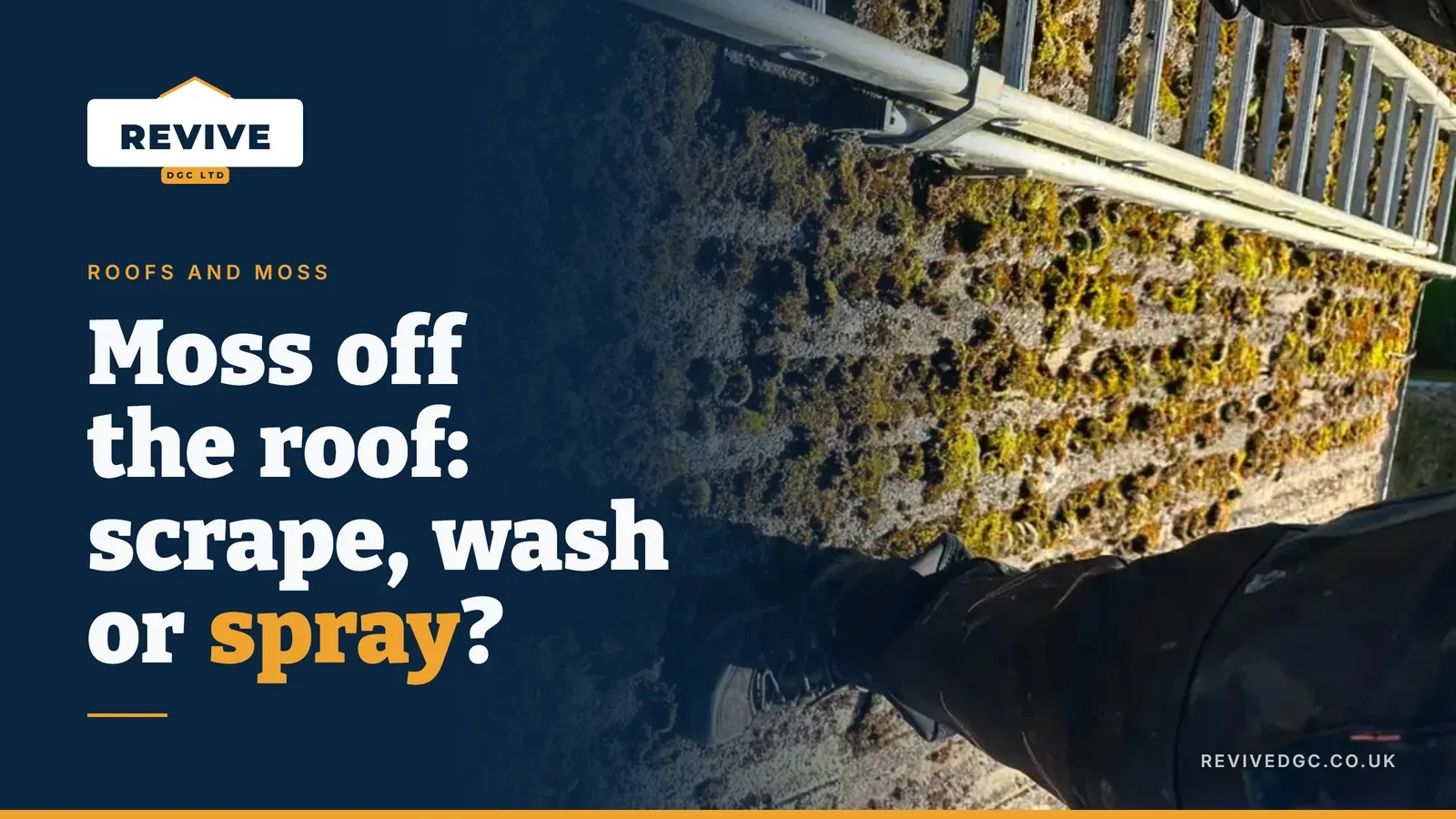
You've finally decided the moss on the roof has to go, and now you've got three different answers. A leaflet through the door offers to jet wash it in a morning, someone else mentions a spray that kills it off, and a third person says it all has to come off by hand. Most houses round here have concrete tiles, and on those my honest pick for roof moss removal is scraping and brushing by hand. I'd keep a pressure washer well away from them, and a spray on its own is slower and does less than people expect. Each one leaves your roof in a different state a year on, and that's the thing worth weighing up when the quotes land on your doormat.
Roof moss removal by hand: scraping and brushing
This is the slow one. Somebody goes up, works across the roof a section at a time and lifts the moss out of the tile laps with a scraper, then brushes the loose stuff down the slope. A roof that's had ten years of growth can take a good while, because thick moss knits itself into the gaps where one row of tiles sits over the next and it has to be prised out rather than swept.
What it leaves you with is the same tiles you started with, just without the moss holding water against them. Nothing has been sprayed at high pressure and nothing has been soaked in chemicals, so there's no surface damage to worry about and no run-off going into your borders. It's also the method that lets whoever's doing it see every tile up close, and that's a real plus. A cracked or slipped tile hiding under a cushion of moss gets found, and with me you'll see a photo of it on the day rather than finding out the hard way next winter.
So yes, it takes longer than a wash, but what you're paying for is a roof left in better shape, rather than one that just looks better for a summer. It's how I clean roofs, and the full detail of how I go about it is on my roof cleaning page.
Why I'd keep a pressure washer off your roof
I understand the appeal. A jet wash is quick, it's satisfying to watch, and for a few months the roof looks like it was laid last week. That's exactly why it gets offered so often.
The trouble is what a high-pressure jet does to a concrete tile. The face of the tile is the hardest, tightest part of it, and it's what sheds the rain. Blast that away and the tile has lost the very part that keeps the water out. Marley, the roof tile maker, say plainly on their own help pages that a jet wash can damage the surface of a tile and cut its life short, so it's hardly just me being fussy. A thick build-up of moss left for years will speed up a tile's wear, but a jet wash can strip that surface off in a single afternoon.
There's the mess as well. Moss and grit blasted off a roof go everywhere: down the walls, across the windows, over the car and next door's car too. A jet aimed up the slope can also push water back under the tile laps, which is the opposite of what a roof is built to do. If anyone tells you a pressure wash is gentle on tiles, I'd ask them what pressure they run it at and how they stop the water going upwards.
What a moss-killing spray can and can't do
A biocide is a moss killer that's sprayed on and then left to do its work, so there's a fair bit of waiting involved. Over the following weeks and months the moss dies off, goes brown and loosens, and the rain gradually washes it down the roof. It's gentle on the tiles, which is its big plus, and on a light green film it can do a reasonable job with very little disturbance.
Where it falls down is on the thick stuff. A dead cushion of moss can sit in the laps for a long time before it breaks up, and when it does come loose it has one place to go, which is your gutters. So a spray on a heavily mossed roof tends to mean months of brown clumps arriving in the gutter and on the drive, and very likely a gutter clear at the end of it anyway. It also won't tell you anything about the state of the tiles underneath, because nobody's had a close look.
If you're quoted for a spray, ask what the product is, what it's approved for, and what they do to keep the run-off away from plants, ponds and pets below. A decent firm will answer all of that without blinking.
What about scraping first and spraying after?
Some firms offer both: the moss comes off by hand, then a treatment goes on to slow down the regrowth. On paper that's the belt-and-braces option, and it's a fair thing to ask about. What I'd want to know before paying extra is how long they reckon it actually holds the moss back on your roof, and what that's based on.
Moss comes back faster on some roofs than others, whatever you put on them. A north-facing slope under a big tree is always going to green up again sooner than an open one that gets the sun all afternoon. So be wary of anyone who promises the moss won't be back for a set number of years. They can't know that, and neither can I.
Which method suits your roof
Before any of this, it's worth asking whether the roof needs touching at all. A faint green tint across the tiles isn't doing much harm, and I'd tell you to leave it. If you're not sure which side of that line yours is on, my article on whether moss actually damages a roof goes through what to look for from the ground.
Once the moss has built up into a raised line along every course, or you keep finding clumps of it on the lawn whenever it's been blowy, it wants lifting off properly, and on concrete tiles that means a scraper and a brush. Older clay tiles and slate are more brittle, so they take a lighter hand and a bit longer, but it's still the right approach. And if there's a damp patch on a ceiling upstairs, sort out the cause before thinking about moss at all. That's usually a slipped tile or tired flashing rather than the moss itself, and it's a job for roof repairs first.
Questions to ask whoever's quoting
Whoever you have round, these are worth asking before anyone climbs a ladder. A good answer to each tells you a lot about how the job will actually be done.
- How will the moss come off, by hand, by jet wash or by spray, and why that way for my roof?
- Who clears out the gutters afterwards, and is that in the price?
- Will you need a tower or scaffold, and is that already in the figure?
- Will I get photos of the roof before and after?
- What happens if you find a broken or slipped tile?
The gutter one catches a lot of people out. Whatever comes down off the tiles lands in them, and a roof clean that leaves the gutters packed is how you end up with water spilling over the lip at the first heavy shower. I clear them out before I leave, and if a clear shows up a cracked joint or a run that's dropped, the gutter repairs page explains what happens next.
Please don't do it yourself off a ladder
I know it's tempting with a long-handled brush and a free Saturday. A mossy roof is slippery even when it's dry, and wet moss on a concrete tile is like standing on soap. Leaning a ladder against the gutter to reach it puts your weight on the one bit of the house least able to take it. If the moss genuinely needs to come off, have someone up there who works on roofs every week and has the right access for that particular roof.
Not sure what yours needs? Get a photo over to me
If you've already been quoted for a jet wash or a spray and you'd like a second opinion, send a photo of the roof to me on WhatsApp at 07515 154559 and tell me what you've been offered. I'll say what I'd do with it and why. I won't put a number on anything till I've been out and had a proper look, and coming out costs you nothing. I cover Mexborough and about twenty miles round it, which takes in Sheffield and Doncaster, and I work weekdays, eight till six.